From Idea to First Bulk Order: The Thai Cosmetics OEM Roadmap (2026)
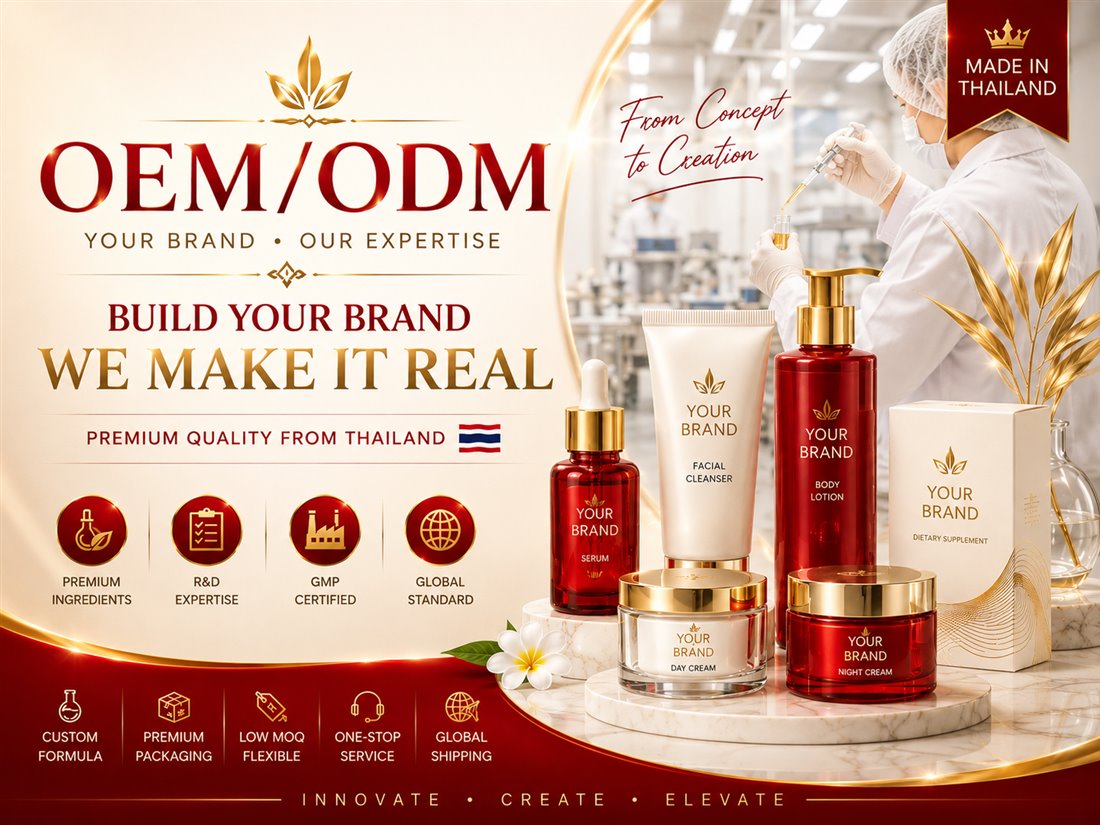
This article is general information for reference.
Every private-label skincare brand built on Thai manufacturing starts the same way: an idea, a target market, and a long list of unknowns. This guide breaks the process into concrete stages so you know what to expect — and what to ask for — before you commit to a Thai cosmetics OEM supplier and place your first container order.
Stage 1: Turn Your Idea into a Brief
Before contacting any factory, define three things: your target market (GCC, Vietnam, Philippines, Indonesia, India, or a mix), your price positioning (mass, masstige, premium), and your product category (facial serum, whitening cream, herbal soap, sunscreen, hair care). A one-page brief covering texture preference, key actives (centella, rice extract, snail mucin, turmeric, mangosteen), fragrance direction and packaging format saves a lot of back-and-forth with the manufacturer.
Questions to Answer First
- Will the product carry halal, vegan, or cruelty-free claims for GCC or Muslim-majority Southeast Asian buyers?
- Do you need existing "ready-made" formulas (usually faster and simpler) or a fully custom formulation (slower, more differentiated)?
- What does your first order need to cover — samples, artwork, and freight?
Stage 2: Shortlist Manufacturers and Request Samples
Reputable Thai OEM houses — many based in Bangkok's industrial belt and the Samut Prakan/Samut Sakhon manufacturing corridor — usually offer a catalog of base formulas (stock formulas) alongside custom development. Request:
- Physical samples of 2–3 comparable existing products before committing to a custom formula
- A documented ingredient list (INCI) and country-of-origin data for key actives
- GMP and ISO 22716 certification proof, and export references to your target region
Sample timing varies by formula, supplier and number of revision rounds — stock-based formulas are usually faster than a new custom formulation; confirm it in the quotation. Some suppliers charge a sample fee; ask whether it can be credited toward the bulk order.
Stage 3: Formulation, Stability and Compliance Testing
Once a sample is approved, the factory runs stability testing (heat, cold, freeze-thaw cycles) to confirm shelf life, texture consistency and separation resistance before scaling to bulk — the duration varies by formula and lab, so confirm it with the manufacturer. This stage also covers:
- Microbial and heavy-metal testing — commonly requested for Thai FDA notification and by many import authorities
- Claims substantiation — whitening, anti-aging or SPF claims need supporting data if your target market (e.g., GCC, India) requires it at customs or on retail shelves
- Halal certification — if selling into GCC or Muslim-majority Southeast Asia, start the halal application in parallel with formulation, since it can add time to the project
Stage 4: Discuss Order Quantities and Pricing Tiers
Order quantity requirements for Thai OEM cosmetics vary by manufacturer, formula type and packaging — fully custom formulas usually need larger production runs than stock formulas, and some manufacturers offer smaller trial runs for first-time brand owners. Ask suppliers about their order quantity options and for a tiered quotation so you can plan your first bulk order and your second-order growth path.
Negotiation Tips
- Bundle multiple SKUs (serum + cream + cleanser) to reach a factory's overall production minimum even if each SKU is below its individual minimum
- Ask whether packaging components (bottles, jars, cartons) are shared across your SKUs — this can lower combined tooling and packaging minimums
- Ask whether pricing can be held for a set number of reorders as you scale distribution across the Philippines, Vietnam, Indonesia, Malaysia or India
Stage 5: Labeling, Artwork and Regulatory Filing
Labeling is where many first-time importers lose time. Requirements differ sharply by destination (general reference only — regulations change, so confirm current requirements with the local authority or a licensed import agent/customs broker before filing):
- GCC: Arabic-English bilingual labeling, GSO/GCC cosmetic notification, and halal logo placement if applicable
- Vietnam: Vietnamese-language sticker or printed label, cosmetic product notification with the Drug Administration of Vietnam (DAV)
- Philippines: FDA Philippines Certificate of Product Registration (CPR) and Certificate of Free Sale from Thailand
- Indonesia/Malaysia: BPOM or NPRA notification, often requiring a local licensed importer of record
- India: BIS/CDSCO cosmetic registration and import license depending on category
Ask your OEM partner whether they can supply the Certificate of Free Sale (CFS), safety data sheet, and INCI declaration your appointed import agent needs to file locally — request these documents in parallel with bulk production, not after the goods ship.
Stage 6: Packaging Approval and Bulk Production
Once labeling artwork is finalized (brand name, batch code, barcode, manufacturing/expiry date format matching your destination country's rules), the factory produces a pre-production sample for final sign-off. Bulk production timing varies by product, supplier and order size — confirm it in the quotation. Production is followed by in-house QC and, if requested, third-party pre-shipment inspection.
Stage 7: First Shipment and Reorder Planning
Your first bulk order is also a pilot test of the whole supply chain — packaging durability in transit, customs documentation accuracy, and sell-through speed in your market. Track sell-through carefully during the first months on shelf so your second order quantity and SKU mix are based on real demand, not projections.
ThaiNex is a Bangkok-based distributor of Thai consumer products. OEM and private-label projects can be discussed — send us your brief and target market. Register free at thainex.com to view wholesale prices, or contact us for a wholesale quotation. Documents may be available on request depending on the product, and we coordinate shipping from Bangkok.